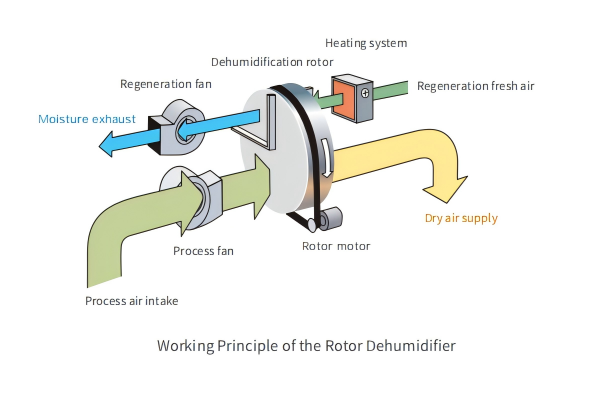
The working principle of the rotary dehumidification system
The dehumidification rotor is divided into the treatment area and the regeneration area within the dehumidification section by a sealing system. The dehumidification rotor rotates at a certain speed slowly to ensure that the entire dehumidification process is continuous. When the treated air passes through the treatment area of the rotor, the water vapor in it is adsorbed by the hygroscopic medium in the rotor, and the water vapor undergoes a phase change and releases latent heat. The rotor also gradually approaches saturation due to the absorption of a certain amount of moisture; at this time, the treated air becomes dry and hot air due to the reduction of its own moisture and the release of latent heat. Meanwhile, in the regeneration area, another stream of air first passes through the regeneration heater, then becomes hot air and passes through the saturated rotor after the hygroscopic medium has been adsorbed, causing the moisture adsorbed in the rotor to evaporate and restoring the rotor's dehumidification capacity; at the same time, the regeneration air becomes humid air due to the evaporation of moisture; subsequently, the humid air is discharged to the outside through the regeneration fan.
The rotor-based dehumidification machine, its main core component is the dehumidification rotor. The rotor is composed of glass fibers and heat-resistant ceramic materials as the internal support carriers of the rotor, combined with special hygroscopic medium materials (such as highly efficient silicate). Thus, the highly efficient hygroscopic agent, together with the rotor's own special honeycomb structure, not only ensures the huge surface area of the rotor's contact with the air, but also improves the rotor's hygroscopic efficiency and increases the hygroscopic capacity; the rotor can be cleaned by gas blowing to remove some mechanical contaminants on the rotor's surface, such as dust, oil stains, etc.
Rotary dehumidifier working principle diagram