
FHCS/FHCD Composite flow Closed Cooling tower
| High-temperature circulating water (or other medium) enters the cooling tower, and heat is transferred through the pipe wall to the spray water outside the pipes. Simultaneously, air enters the tower from the top, flowing over the surface of the cooler and exchanging heat with the spray water. In this process, the circulating water temperature decreases, becoming low-temperature water, while the spray water temperature increases and remains relatively stable, and the air temperature increases, becoming high-temperature, high-humidity air. The low-temperature circulating water then re-enters the main unit (the equipment being cooled) to absorb heat. The spray water flows through the packing material, exchanging heat again with the air entering the tower from the side. | 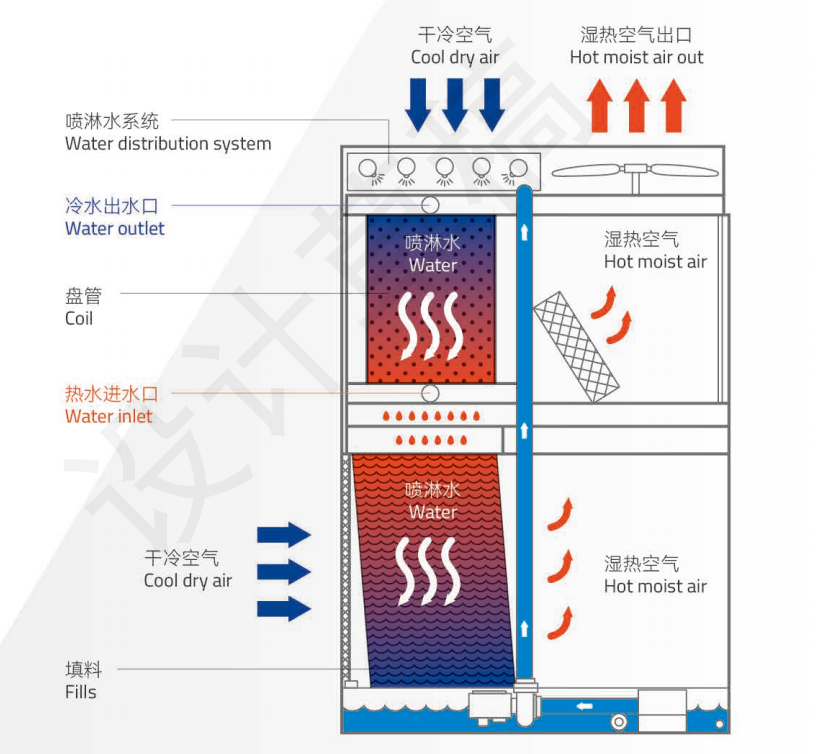 |
In this process, the spray water temperature further decreases, becoming low-temperature water, and the air temperature increases, becoming high-temperature, high-humidity air. The low-temperature spray water falls into the collection tank and is reused, and the two streams of high-temperature, high-humidity air are discharged from the tower by a fan.
Single-inlet compound flow

Dual-inlet compound flow
The spray water completely envelops the heat exchange tubes, preventing "dry spots," ensuring full utilization of the heat exchange surface area and reducing scaling;
The addition of packing material allows for secondary cooling of the spray water, lowering its temperature and improving the heat exchange efficiency of the cooler;
The airflow passes through the cooler in the same direction as the spray water flow, and the airflow passes through the packing material perpendicular to the spray water flow. This design reduces wind resistance, resulting in relatively lower energy consumption for the cooling tower and greater energy efficiency;
The circulating water does not come into contact with the outside air and is not affected by the external environment. The circulating water quality is cleaner and more stable, improving the operating efficiency of the main unit (the equipment being cooled) and reducing maintenance costs;
It occupies a small footprint when multiple units are combined.
FNC Counter flow Closed Cooling tower
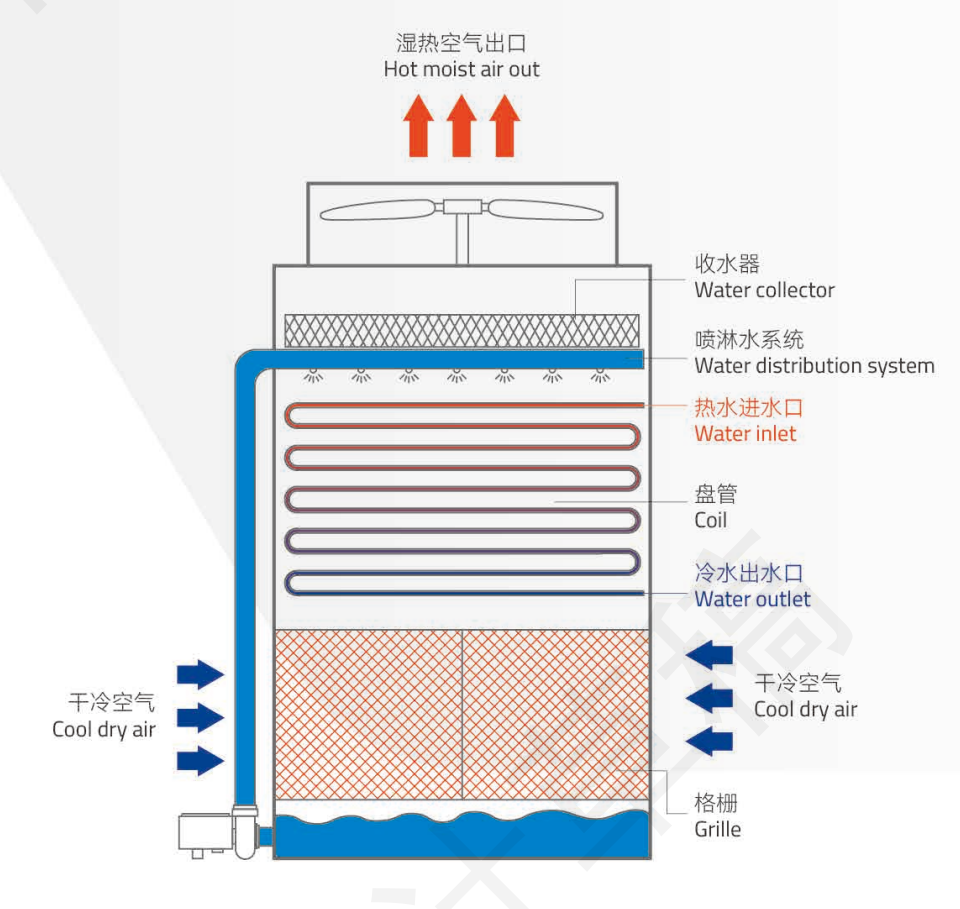 | High-temperature circulating water (or other medium) enters the cooler inside the tower. Heat is transferred through the pipe wall to the spray water outside the pipes. Simultaneously, air enters the tower from all sides at the bottom, flowing across the surface of the cooler and exchanging heat with the spray water. During this process, the circulating water temperature decreases, becoming low-temperature water, while the spray water temperature remains relatively constant, and the air temperature increases, becoming high-temperature, high-humidity air. The low-temperature circulating water then re-enters the main unit (the equipment being cooled) to absorb heat. The spray water falls into the collection tank and is reused, and the high-temperature, high-humidity air is expelled from the tower by a fan. |
Simple design, stable operation, and compact structure;
The airflow and spray water flow inside the tower are parallel and in the same direction, allowing for more efficient heat exchange between the spray water and the air;
Small footprint when used individually;
Less prone to icing in winter, making it more suitable for use in northern regions.
FEC Evaporative Condenser
Evaporative condensers operate on a similar principle to conventional closed-circuit cooling towers. The difference is that in conventional closed-circuit cooling towers, both the heat transfer medium entering and exiting the tower are in liquid form, with only a change in temperature. In contrast, in an evaporative condenser, the heat transfer medium entering the tower is in a gaseous state, and after passing through the tower, it is condensed into a liquid state. An evaporative condenser is a product that combines the functions of a cooling tower and a condenser. | 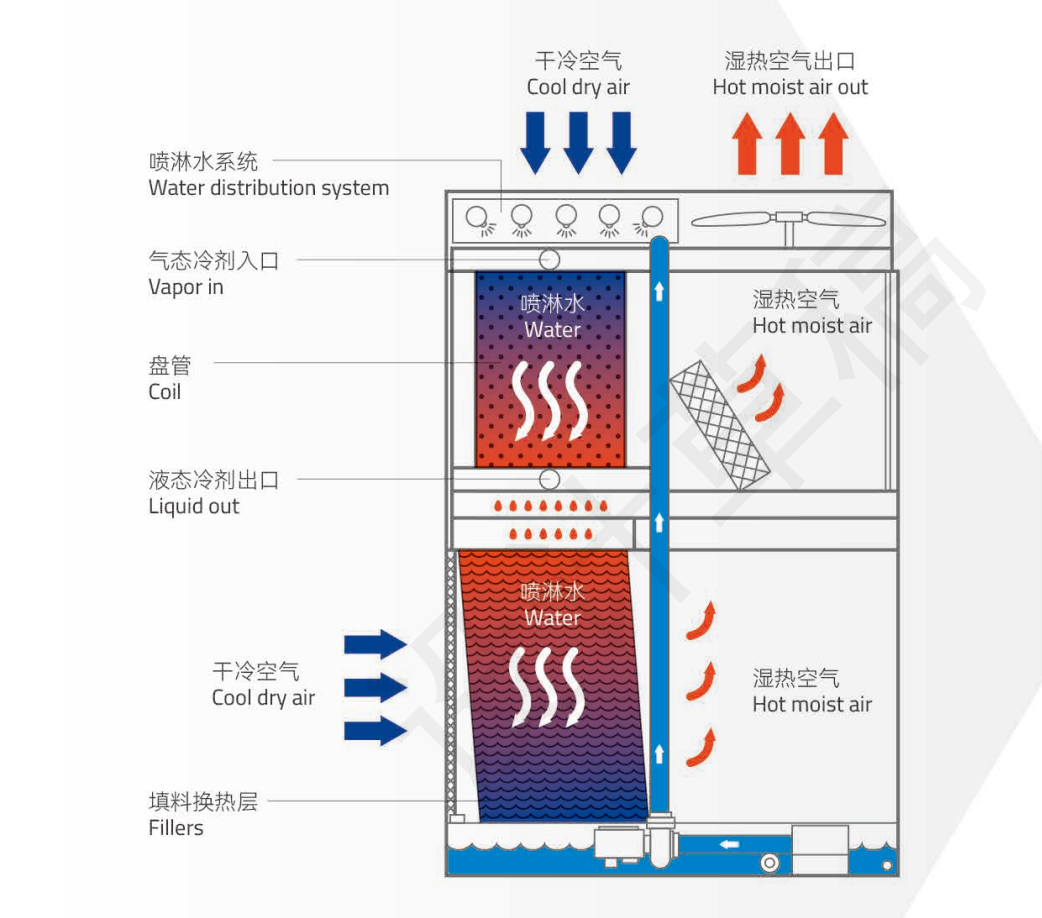 |
Lower operating costs and more energy-efficient compared to conventional cooling systems;
Simpler circulation system, reducing installation costs;
Saves more equipment installation space compared to conventional cooling systems.


