Views: 0 Author: Site Editor Publish Time: 2026-06-05 Origin: Site
Understanding thermal system mechanics goes beyond basic science. It serves as a necessary prerequisite for high-stakes capital expenditure and facility management decisions. Facility leaders face immense pressure to optimize production environments. Misunderstanding how industrial-scale thermal management works often leads to critical errors. Planners might under-specify equipment capacities. This oversight directly causes mechanical failure and severe compliance breaches. Conversely, over-specifying hardware wastes significant energy and upfront operational capital.
Our goal is to explain the functional mechanics of industrial climate control clearly. We translate these complex thermodynamic mechanisms into actionable evaluation criteria. Procurement teams and facility engineers can leverage this knowledge to align hardware specifications with precise production goals. You will learn exactly how to balance mechanical loads against operational realities. By mastering these principles, you prevent costly production downtimes and optimize long-term efficiency.
An industrial HVAC system operates on the same baseline thermodynamic principles as standard cooling but is engineered for continuous operation under severe sensible and latent heat loads.
System efficacy relies heavily on the integration of the AHU(Air Handling Unit) with specialized chillers and localized industrial air conditioners.
Environments requiring strict manufacturing tolerances demand Constant Temperature And Humidity Air Conditioners to prevent product degradation.
Evaluating a system requires balancing mechanical capacity with long-term OPEX, structural facility constraints, and BMS (Building Management System) integration risks.
To grasp the mechanics, we must first recognize the scale difference. Commercial comfort cooling targets human occupants. It generally maintains temperatures around 72°F (22°C) alongside moderate humidity. Industrial process cooling faces a completely different mandate. It protects mission-critical equipment and delicate manufacturing processes. Heavy machinery, such as plastic injection molders or server racks, generates massive sensible heat. A well-engineered industrial HVAC system runs continuously to mitigate these extreme thermal outputs.
All refrigeration systems rely on a continuous loop of heat absorption, transport, and rejection. Industrial layouts simply amplify this cycle. Evaporators absorb indoor heat. Compressors pressurize the refrigerant gas. Condensers reject this heat into the outdoor atmosphere. Finally, expansion valves reset the pressure cycle. Industrial facilities utilize expansive chilled water loops and specialized refrigerants to move thermal energy. Massive ductwork networks then transport the conditioned air across thousands of square feet. The scale requires robust engineering to prevent energy loss during transport.
Temperature control represents only one half of the equation. Indoor air quality (IAQ) demands equal attention. Manufacturing processes frequently release airborne contaminants, volatile organic compounds (VOCs), and dense particulates. The system must exhaust these hazards safely. As exhaust fans pull contaminated air out, the system must introduce fresh makeup air. This replacement air prevents negative building pressurization. Proper pressurization keeps unconditioned outdoor air from seeping through doors and cracks. It also satisfies strict OSHA safety standards for occupational health.
Understanding the individual parts helps you evaluate the whole mechanism. An industrial facility relies on several heavy-duty components working in unison. They form the mechanical engine driving environmental stability.
Consider the AHU(Air Handling Unit) as the central nervous system for air distribution. It does not generate cold or heat directly. Instead, it conditions and circulates the air. A heavy-duty blower fan pulls air through thick filtration media. These filters trap microscopic industrial particulates. The unit then mixes recirculated return air with fresh outside air. Finally, it forces this mixed air over chilled water or direct expansion (DX) coils. The resulting conditioned air travels through the ductwork to reach the factory floor.
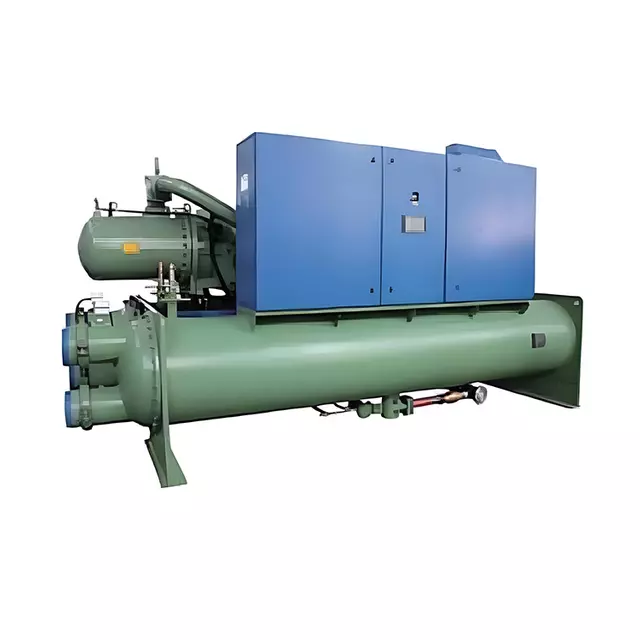
Chillers and boilers provide the primary thermal generation. Chillers cool water down to roughly 45°F (7°C). Pumps then push this water to the air handling units. Industrial chillers typically fall into two categories: air-cooled and water-cooled. Water-cooled variants utilize external cooling towers to reject heat. They offer exceptional efficiency for massive facilities. Boilers generate hot water or steam to handle winter heating loads and humidity control processes.
Chiller Type | Cooling Mechanism | Space Requirement | Best Application |
|---|---|---|---|
Air-Cooled | Ambient air blown across condenser coils. | Requires outdoor roof or ground space. | Mid-sized facilities lacking water infrastructure. |
Water-Cooled | Cooling towers reject heat via water evaporation. | Requires dedicated indoor mechanical room. | Large-scale manufacturing plants needing peak efficiency. |
Central plants handle massive spaces, but localized cooling requires different tactics. Facility engineers often deploy standalone Industrial Air Conditioners. These heavy-duty packaged or split units cool specific zones independently of the central loop. You might install them in server control rooms, electrical substations, or high-heat operational nodes. Decentralizing these loads prevents the central chiller from overworking. It also provides vital redundancy for isolated critical systems.
Standard cooling systems fluctuate. Ambient temperatures might drift by three or four degrees before the compressor engages. While humans barely notice this drift, sensitive manufacturing environments suffer catastrophic consequences.
Standard configurations fail in strict compliance environments. Semiconductor manufacturing requires absolute particle and temperature control. A tiny temperature shift expands metal microscopic traces, ruining silicon wafers. Pharmaceutical compounding demands strict humidity caps to prevent powder clumping and microbial growth. Food processing facilities face similar microbiological risks. These mission-critical applications require an entirely different class of equipment to maintain environmental integrity.
Precision cooling relies on simultaneous processes. To achieve this, facilities install Constant Temperature And Humidity Air Conditioners. They manage sensible heat (temperature) and latent heat (moisture) concurrently. Standard units drop the temperature to remove humidity, often overcooling the space. Precision units cool the air below the dew point to strip out moisture. However, they immediately activate an internal reheat coil. This reheat mechanism brings the dry air back up to the exact required setpoint. The room stays perfectly dry without becoming uncomfortably cold.
Hardware alone cannot achieve microscopic tolerances. These units rely on advanced microprocessor-based controls. Precision sensors monitor the return air continuously. They detect fluctuations within fractions of a degree or single percentage points of humidity. PID (Proportional-Integral-Derivative) controllers calculate the exact cooling or heating response needed. They modulate valves and fan speeds instantly to prevent environmental drift.
Performance Chart: Standard vs. Precision Cooling | ||
Metric | Standard HVAC Unit | Precision AC Unit |
|---|---|---|
Temperature Variance | ± 3°F to 5°F | ± 0.5°F to 1°F |
Humidity Control | Passive (Often drifts by 10-15%) | Active (Maintained within ± 2-5%) |
Run Cycle | On/Off Cycling | Continuous, modulated operation |
Sensible Heat Ratio (SHR) | 0.60 - 0.70 | 0.85 - 0.95 (High equipment heat) |
Translating mechanical theory into a procurement specification requires careful evaluation. You must match the system capabilities to your facility's exact requirements.
Engineers must assess current peak thermal loads accurately. This involves calculating both sensible heat from machinery and latent heat from moisture. Common mistake: Sizing equipment solely for peak summer loads. This practice frequently causes "short-cycling" during winter months. The oversized unit blasts cold air, satisfies the thermostat instantly, and shuts off before removing humidity. Instead, specify modular components. You can start with a baseline capacity and install additional chiller modules later as your production line expands. This prevents immediate over-capitalization.
Industrial systems consume massive amounts of electricity. Managing your operational expenditure (OPEX) is crucial. You should evaluate three specific technologies during procurement:
Variable Frequency Drives (VFDs): These devices modulate fan and pump motor speeds. Instead of running at 100% capacity constantly, the motors slow down during periods of low thermal demand.
Economizers: These dampers utilize cool outdoor air to condition the facility. This "free cooling" reduces compressor workload during temperate seasons.
Energy Recovery Ventilators (ERVs): ERVs capture thermal energy from exhaust air. They transfer this energy to precondition incoming fresh air, drastically lowering heating and cooling loads.
You must evaluate systems against strict industry standards. Pharmaceutical plants require adherence to FDA Good Manufacturing Practices (GMP). Electronics manufacturers follow ISO cleanroom classifications (such as ISO 7 or ISO 8). Furthermore, you must build mechanical redundancies into the design. An N+1 redundancy model ensures you have one independent backup module for every primary system. If a chiller fails, the backup takes over automatically. This prevents catastrophic downtime and product spoilage.
Procuring the right equipment solves only half the problem. You must also navigate the physical and logistical realities of installation.
Industrial components carry immense physical weight. You must audit roof loading capacities before hoisting a 10-ton chiller onto a commercial structure. Reinforcing steel dunnage often adds unexpected costs to the project. Furthermore, mechanical rooms require adequate spatial clearance. Technicians need room to pull heat exchange coils for cleaning. Finally, complex ductwork routing often clashes with existing plumbing and electrical trays. You must resolve these spatial conflicts during the design phase.
Modern equipment must communicate with your central monitoring network. Tying new hardware into legacy Building Management Systems (BMS) presents technical risks. Ensure your new units utilize open communication protocols like BACnet or Modbus. Centralized dashboards allow operators to monitor humidity trends remotely. Furthermore, modern integration enables predictive maintenance. Sensors can detect gradual coil pressure drops, alerting technicians to change filters before a failure occurs.
Retrofitting heavy HVAC infrastructure inside an active facility requires meticulous planning. You cannot halt a profitable production line for a month. We recommend structuring a phased rollout to minimize operational disruption. Follow this proven deployment sequence:
Temporary Cooling Deployment: Install rental chillers or portable units to maintain critical zones during the primary shutdown.
Infrastructure Retrofitting: Upgrade electrical panels, structural supports, and piping while the old system still operates on life support.
Component Swap and Integration: Remove legacy hardware and crane the new components into position over a planned weekend or holiday shutdown.
Final Commissioning: Test sensor logic, balance ductwork airflow, and verify all redundant backups operate correctly under simulated failure conditions.
Understanding the functional mechanics of industrial HVAC components forms the ultimate foundation for specifying your facility's climate control. By mastering the differences between comfort cooling and process cooling, you protect mission-critical equipment. You can confidently select specialized units to manage airborne contaminants, tight thermal tolerances, and massive heat loads.
Your next step requires turning this knowledge into data. Initiate a comprehensive thermal load audit of your manufacturing floor. Assess your current structural capacities to determine placement viability. Finally, consult with an industrial engineering specialist to transition your findings from preliminary research into a strict, actionable procurement specification. Doing so protects your capital investment and ensures uninterrupted production.
A: A standard commercial AC contains both the cooling compressor and distribution fan in one unit. An AHU primarily handles air distribution, filtration, and mixing. It relies on a separate central plant (like a chiller or boiler) to supply hot or cold water to its internal coils. AHUs also support much higher static pressures and volumes.
A: These precision units utilize a simultaneous cooling and reheat cycle. First, the evaporator coil cools the air below its dew point, forcing moisture to condense and drain away. Next, an internal reheat mechanism warms the dry air back to the precise required setpoint before blowing it into the room.
A: A well-maintained system typically lasts between 15 and 25 years. However, this lifespan strictly depends on operational conditions. Harsh environments with corrosive airborne chemicals shorten equipment life. Aggressive, scheduled preventative maintenance and regular coil cleaning are required to reach the 25-year mark.
A: Evaluate your facility layout and zone requirements. If the entire plant requires a uniform temperature, a centralized chiller loop offers the best efficiency. If you have a few isolated high-heat areas, or if distinct rooms require vastly different temperatures, decentralized air conditioners provide better control and operational flexibility.