Views: 0 Author: Site Editor Publish Time: 2026-06-09 Origin: Site
Upgrading or installing a high-capacity climate control system requires serious planning. You must navigate a massive gap in scale, cost, and complexity. Misidentifying your facility requirements often leads to catastrophic downtime. It can also trigger severe regulatory fines or bloated energy expenditures. We understand how overwhelming system selection feels. Facilities face immense pressure to keep operations running smoothly.
While commercial systems prioritize human comfort and modular deployment, an industrial HVAC system is engineered differently. It guarantees process stability, continuous operation, and extreme load management. Applying the wrong standard inevitably creates operational bottlenecks.
This guide gives you a rigorous, evidence-based framework. You can use it to evaluate precise facility needs. Facility managers, procurement teams, and operations directors will learn to assess system categories accurately. You will discover how to mitigate severe implementation risks before signing a contract.
Primary Objective: Commercial systems manage occupancy comfort (temperature/airflow); industrial systems protect critical manufacturing processes, handle toxic exhaust, and maintain strict environmental thresholds.
Capacity & Scale: Commercial units typically range up to 25 tons, relying on standardized rooftop units (RTUs) or VRF. Industrial facilities frequently demand 50+ ton custom configurations, utilizing heavy-duty chillers and specialized filtration.
Downtime Stakes: Industrial system failures incur immediate production losses and safety hazards, necessitating predictive maintenance and built-in redundancy, whereas commercial downtime primarily impacts occupant comfort.
Regulatory Risk: Industrial systems face stringent compliance mandates regarding airborne pollutant management and occupational health, extending far beyond standard municipal building codes.
You must establish your primary facility objective before selecting equipment. Commercial and industrial systems serve fundamentally different operational goals. They use entirely distinct engineering logic to achieve success.
Engineers design commercial systems specifically for offices, retail stores, and hospitality venues. These environments prioritize basic human comfort above all else. They focus heavily on balancing indoor air quality (IAQ) and ambient temperatures. Facilities usually base these calculations on highly predictable occupancy schedules. Most office buildings operate on standard daily hours, allowing systems to power down overnight.
For commercial installations, success criteria look straightforward. Facility managers aim to lower seasonal energy costs. They simultaneously maintain a comfortable 68–74°F baseline temperature for employees and customers. If the ambient temperature fluctuates slightly, the worst outcome usually involves minor occupant complaints.
Industrial applications handle a much harsher reality. Facilities like manufacturing plants, refineries, chemical processing centers, and massive data centers require specialized setups. They focus entirely on process-centric goals. These systems must aggressively neutralize extreme heat loads generated by heavy machinery. They also safely exhaust hazardous airborne pollutants from the workspace.
Success criteria in these environments leave no room for error. Facilities demand uninterrupted 24/7/365 operational stability. Equipment must guarantee product integrity and absolute worker safety under extreme environmental stress.
Common Mistake: Many facility managers assume human comfort logic applies to factory floors. Attempting to cool a high-heat manufacturing line using human-centric design inevitably leads to rapid equipment burnout.
The sheer physical size and cooling capacity separate these two categories instantly. Industrial environments require exponential power scaling to handle factory heat generation.
Engineers measure cooling capacity in "tons." One baseline ton of cooling equals 12,000 BTUs (British Thermal Units) per hour. Commercial installations frequently utilize modular setups. These typically range from modest 5-ton units up to 25-ton configurations. They cool partitioned spaces efficiently.
Conversely, industrial facilities scale their requirements exponentially. They routinely require custom-engineered centralized plants producing 50-ton to 100+ ton capacities. Heavy manufacturing spaces push these limits even higher to overcome massive latent heat.
Commercial deployment relies heavily on standardized, mass-produced equipment. Contractors favor packaged air conditioners, variable refrigerant flow (VRF) systems, and multi-split units. Manufacturers optimize these for quick installation and a minimal physical footprint.
Industrial deployments reject standard packaging. They utilize heavy-duty Industrial Air Conditioners built for continuous abuse. Facilities build massive, customized mechanical infrastructures. These include large cooling towers, complex air separators, and high-capacity industrial boilers.
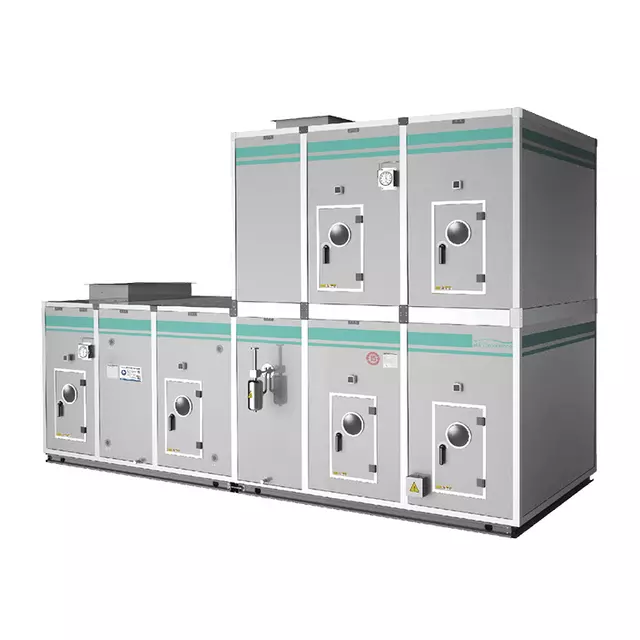
Airflow requirements also dictate completely different architectures. Industrial spaces integrate high-capacity AHU(Air Handling Unit) modules. Engineers tailor these specifically for heavy particulate filtration and chemical scrubbing. The ductwork requires custom fabrication to withstand high-velocity airflow. These environments also feature complex fluid-cooling loops completely absent in commercial retail spaces.
Metric | Commercial Systems | Industrial Systems |
|---|---|---|
Average Capacity | 5 to 25 Tons | 50 to 100+ Tons |
Core Components | RTUs, VRF, Split Units | Chillers, Boilers, Cooling Towers |
Filtration Level | Standard IAQ (MERV 8-13) | Hazardous Material / HEPA / Scrubbers |
Design Approach | Modular & Standardized | Highly Customized & Centralized |
Standard architectural parameters easily accommodate commercial units. Industrial facilities demand aggressive structural adaptations and extreme environmental precision.
Many specialized manufacturing scenarios tolerate zero environmental variance. Pharmaceuticals, sensitive electronics, and food processing facilities face strict production rules. They require dedicated Constant Temperature And Humidity Air Conditioners. This equipment actively prevents material degradation or chemical instability. Even a minor humidity spike can ruin millions of dollars in pharmaceutical inventory.
Commercial zoning relies heavily on smart thermostats. These devices adapt primarily to solar heat gain and localized room occupancy. They slowly adjust dampers to maintain ambient comfort.
Industrial zoning operates on a much faster, critical timeline. It relies entirely on Programmable Logic Controllers (PLCs). These controllers integrate directly with factory facility management systems. They respond instantly to sudden equipment heat spikes. When a blast furnace opens, the system instantly ramps up targeted exhaust capabilities to protect workers.
You cannot simply place industrial components on a standard roof. Industrial systems require deeply reinforced structural supports. They need dedicated mechanical yards isolated from the main workspace. Facilities must install heavy acoustic dampening. This handles the intense vibration and noise generated by heavy-duty compressors. In contrast, commercial RTUs fit seamlessly into standard architectural parameters without needing steel reinforcement.
Best Practice: Always consult structural engineers before upgrading an industrial mechanical room. The sheer weight and vibration of a 100-ton chiller require dedicated vibration-isolation slabs to prevent building damage.
You must shift your maintenance mindset entirely when managing industrial equipment. The financial stakes of system failure demand aggressive, proactive management.
Commercial HVAC service generally follows a predictable, seasonal schedule. Technicians perform quarterly filter changes. They conduct bi-annual coil checks before summer and winter. If a component fails between visits, the repair process remains primarily reactive.
Industrial operations require continuous, aggressive lifecycle management. Maintenance here is strictly predictive. Technicians do not wait for parts to break. They rely on real-time vibration analysis to detect bearing wear. They use thermal imaging on electrical panels and perform weekly fluid sampling on chillers. They identify and swap failing components weeks before an actual breakdown occurs.
Consider the actual impact of unexpected downtime. Commercial downtime usually results in temporary localized closures. It generates uncomfortable employees or annoyed retail customers. The financial loss remains limited to a few hours of standard commerce.
Industrial downtime halts entire production lines instantly. It risks thousands of dollars in lost revenue every single hour. It causes raw inventory spoilage. It also creates massive potential for mechanical damage to uncooled processing equipment nearby. A halted data center cooling loop can fry millions in server hardware within minutes.
Because downtime proves catastrophic, industrial deployments demand strict failover architectures. They utilize redundant layouts to ensure zero-interruption service.
N+1 Redundancy: Provides one independent backup component for every vital system part. If one chiller drops, the backup immediately assumes the load.
N+2 Redundancy: Adds a secondary layer of protection. This covers simultaneous breakdowns or extreme emergency maintenance during a primary failure.
Secondary Power Loops: Guarantees dedicated electrical feeds bypass standard grid interruptions to keep critical ventilation active.
Legal compliance separates standard building management from high-stakes industrial operations. Ignorance of industry-specific regulations carries massive legal risk.
Commercial compliance feels relatively straightforward. Local municipal building codes govern these spaces. They follow basic ASHRAE standards focused heavily on providing adequate fresh air ventilation for humans. Fire dampers and standard exhaust fans usually satisfy local inspectors.
Industrial facilities face brutal, strict oversight from federal agencies. Organizations like OSHA and the EPA monitor these environments closely. The systems must actively capture toxic chemical emissions. They must safely manage combustible dust to prevent catastrophic explosions. They must adhere strictly to severe occupational health mandates regarding airborne exposure limits.
Failure to specify correct exhaust and filtration limits carries massive risk. In an industrial setting, insufficient ventilation leads directly to severe regulatory penalties. Inspectors will issue immediate facility shutdowns if air quality drops below legal safety thresholds. You cannot negotiate these compliance limits.
Choosing the correct system architecture demands methodical evaluation. Use this framework to align your facility requirements with the appropriate equipment class.
Step 1: Conduct a Comprehensive Load Calculation. Move far beyond basic square footage rules of thumb. You must calculate the exact sensible and latent heat loads generated by all onsite machinery. Factor in peak production schedules and heavy equipment cycling to find your true BTU requirement.
Step 2: Assess Expansion Roadmaps. Look at your facility's future growth. Choose modular commercial systems for easily partitioned office or retail spaces. However, you should invest in scalable central industrial plants if your core manufacturing capacity will increase over the next five years.
Step 3: Engage Specialized Engineering. Avoid standard commercial contractors for high-stakes factory environments. You must require partners with proven industrial portfolios. Demand to see their specialized compliance expertise regarding EPA and OSHA ventilation mandates.
You now understand the critical dividing lines between these two system architectures. Do not apply commercial criteria to industrial problems. Attempting to cool heavy manufacturing environments with standard commercial equipment guarantees premature system failure. It ultimately creates expensive operational bottlenecks and safety hazards.
Industrial HVAC demands custom engineering, predictive maintenance, and exact precision. Protect your manufacturing processes by respecting the necessary scale. Your next step should involve initiating a specialized engineering audit. Conduct a rigorous facility risk assessment before you ever begin drafting procurement RFPs.
A: Commercial units typically operate within a 5-ton to 25-ton range, cooling standard offices or retail spaces. Industrial systems establish a baseline around 50 tons. They frequently scale well past 100+ tons to handle extreme heat from manufacturing lines and heavy machinery.
A: Yes, but only in isolated administrative areas. While VRF is highly efficient for office zones within a factory, it lacks the raw cooling capacity required for heavy process cooling. It also cannot manage toxic exhaust or combustible dust clearance.
A: Custom Air Handling Units are absolutely necessary for specialized filtration and high-volume air turnover. They provide exact humidity control to protect sensitive products. They easily surpass standard commercial air handlers, which cannot accommodate chemical scrubbers or HEPA-grade hazardous material filtration.
A: Commercial units generally require seasonal checkups and quarterly filter changes. Industrial systems demand continuous monitoring. Maintenance teams utilize daily or weekly operational diagnostics, vibration analysis, and thermal imaging to prevent catastrophic production line shutdowns.